Miss Diagnosed
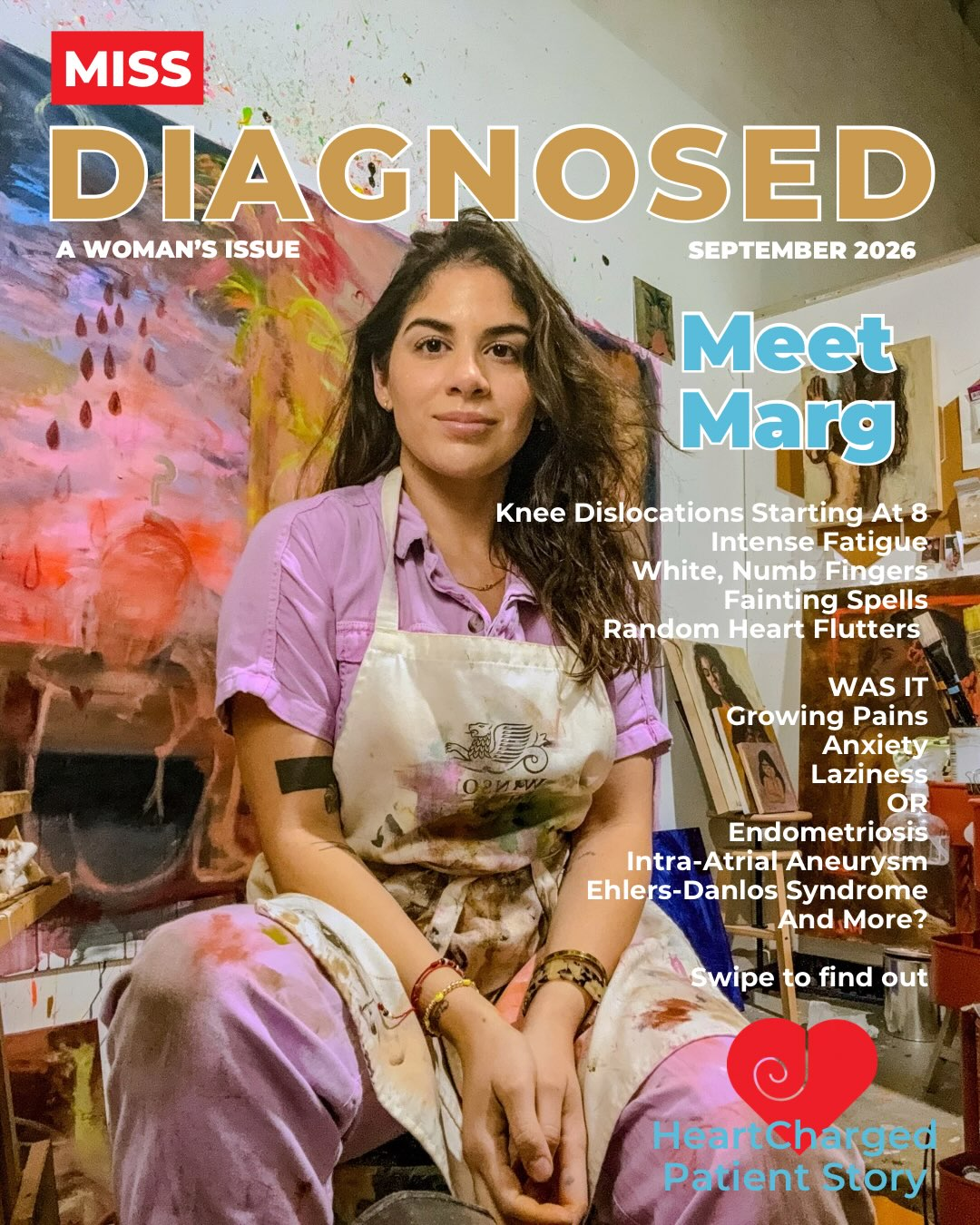
Meet Marg
Marggie lived with severe joint pain, fatigue, migraines, fainting, and other unexplained symptoms for decades before receiving diagnoses of Ehlers-Danlos Syndrome and POTS. As an ER nurse, artist, and lifelong patient, she now shares her story to advocate for listening to patients and connecting the puzzle pieces.
Patient Story Misdiagnosed
My Story
Hi, my name is Marggie.
I’m 36 years old, and I was just formally diagnosed earlier this year with Ehlers-Danlos Syndrome, despite it affecting my quality of life for as long as I can remember.
I suffered my first knee dislocation at 8 years old. Even before that, I remember complaining about severe joint pain as a kid, and my pediatrician would just chalk it up to growing pains.
By my senior year of high school, the dislocations had become so frequent that I spent months at a time in a wheelchair.
I spent countless hours in physical therapy through middle and high school, yet no physical therapist or doctor thought to dig deeper into why this kid kept getting hurt. They’d just tell me to work out and it would get better.
It never did.
Eventually I had two knee surgeries to stop the constant subluxations and dislocations.
I spent my freshman year of college on crutches, taking strong pain pills just to get through class. I’d often fall asleep in the middle of lectures from the drugs.
My first years working 12-hour shifts as a nurse were awful. I took ibuprofen around the clock just to get through, because my knees and hips were killing me. My fatigue was so severe I’d sleep 20 hours after a shift and still feel completely winded.
On top of the joint issues, my body kept throwing new problems at me that I never connected to each other.
Migraines that would flatten me for days. Sudden bouts of vertigo that made a room feel like it was tilting. My fingers turning white and numb in the cold, even in Miami.
Endometriosis pain that doctors treated as a separate, unrelated issue, never asking why someone so young was dealing with so much at once.
And since my teens, unexplained fainting spells and a heart that would flutter out of my chest at random, with nausea and near-fainting that doctors dismissed as anxiety.
My lifelong fatigue got written off by some as laziness.
When the Pieces Started to Fit
Eventually, one night I fainted several times and had to be taken to the ER I worked at. That’s where I finally started getting answers, from doctors who knew me personally and could tell something was really wrong.
My echo showed an intra-atrial aneurysm, which led my doctor to suspect, along with everything else going on with me, that all of it—the joints, the migraines, the vertigo, the Raynaud’s, the endo, the fainting—might be connective tissue and dysautonomia talking.
That set off an in-depth rheumatology and genetics workup that confirmed EDS, which I’d suspected all along, alongside POTS.
Had I not been a nurse myself, I don’t know if I would have ever reached the answers I have today, or the ones I’m still looking for.
Navigating the healthcare system while chronically in pain or exhausted is hard enough, especially when your symptoms don’t fit into one neat diagnostic box.
“Just because you don’t have the answers yet doesn’t mean you won’t find them.”
Art, Healing, and Advocacy
During COVID, like so many others, I turned to creativity during quarantine after seeing more death than I had ever seen in my career.
I was going through divorce at the same time and started having pain flare-ups due to the stress.
For the first time in many years, I turned to art as I did when I was younger for comfort and for enjoyment.
I playfully started drawing and illustrating books I was reading on my iPad, then acrylics and eventually tried oil painting in 2022.
It all began as play, but through this playing and experimentation, I found a piece of myself I had abandoned and found healing and a new supportive and passionate community to be a part of.
Today, I work out of my art studio in Little Havana and make paintings visually and conceptually anchored in the human body, where I explore themes of mental health, self-identity, self-love, and chronic illness.
Being both an emergency room nurse and a life-long patient informs my art career—the artmaking itself and the connections and opportunities I wish to be a part of.
This fall, I’ll be showing a new painting with FLARE (flareendo.org) as part of their inaugural exhibition in NYC, a piece about leaning into rest and community.
It’s been a comfort getting to know other artists in this space and learning about their processes and journeys, especially around chronic illness.
Being part of FLARE feels like a natural extension of my practice, using art not just to process my own experience but as a form of health advocacy, and continuing to build the kind of connection and community that brought me back to art in the first place.
Why I’m Sharing My Story
I’m sharing my story because as an ER nurse, I see how often we dismiss patients who come in with “vague” symptoms, or who are “frequent fliers,” as hypochondriacs or anxious.
I was that patient once.
We all need someone to advocate for us, to listen carefully and put the puzzle pieces together.
“Just because you don’t have the answers yet doesn’t mean you won’t find them.”