Miss Diagnosed
Meet Faydra
Faydra was told that her difficulty keeping up in gym class was due to being out of shape—until she suffered cardiac arrest at 13 and was diagnosed with hypertrophic cardiomyopathy. After later experiencing heart failure during pregnancy and AFib, she now shares her story to encourage others to listen to their bodies and advocate for proper care.
Patient Story Misdiagnosed
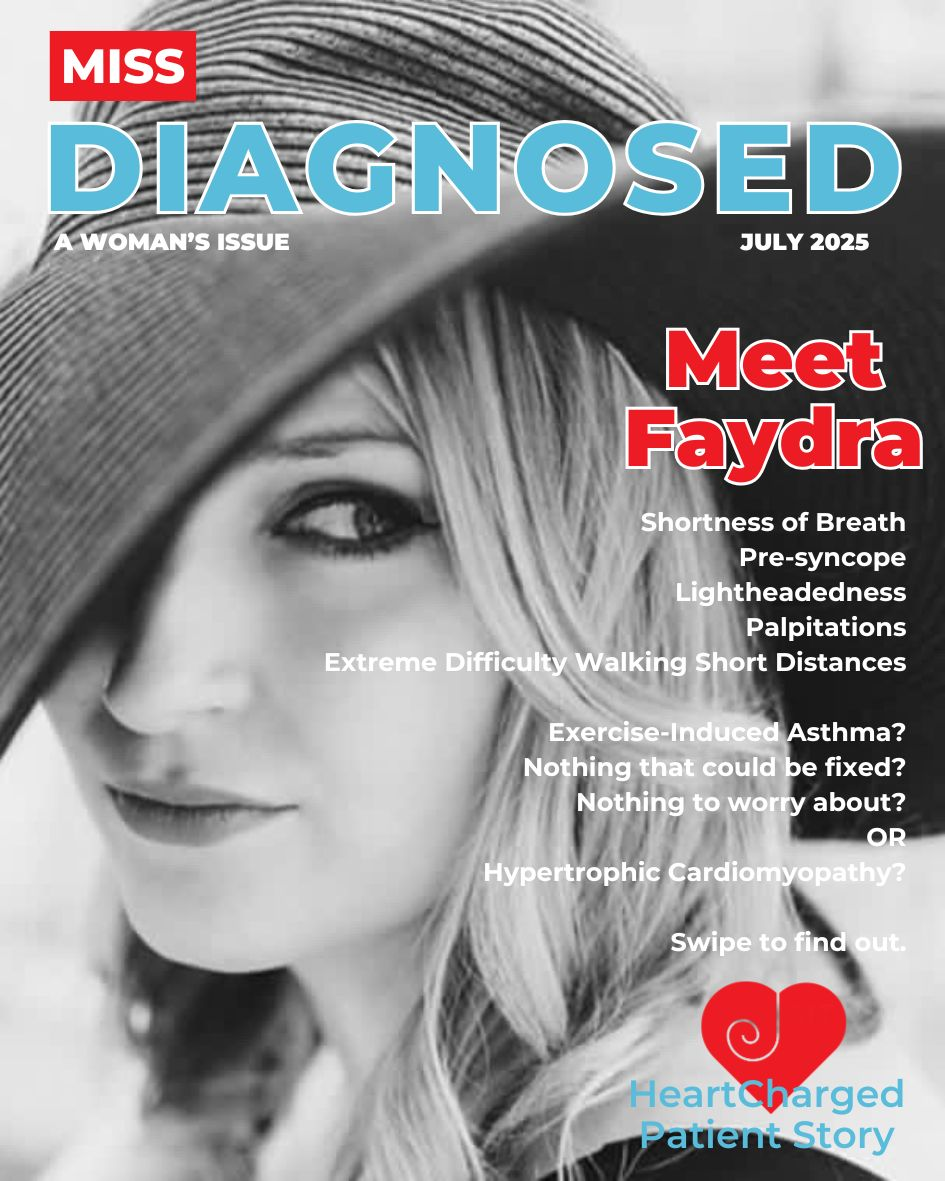
Shortness of breath · Pre-syncope · Lightheadedness · Palpitations · Extreme difficulty walking short distances
Exercise-induced asthma?
Nothing that could be fixed?
Nothing to worry about?
OR
Hypertrophic cardiomyopathy?
Childhood Symptoms
Hello, my name is Faydra.
As a child, I dreaded gym class. We always had to do a warm-up jog, and the teacher would yell at us if we stopped to take a break.
It was only three minutes, but by the end, I felt like it was a torture session. I had shortness of breath. I constantly had trouble keeping up with the other kids in gym class.
Adults, like my gym teachers, told me that probably I just wasn’t conditioned enough and was out of shape. They said maybe I needed to consider doing sports like other kids and that this would help me become more acclimated to physical activity.
I had avoided playing sports because I got tired easily.
I would also feel like my heart would almost skip a beat. I asked my mom to ask a cardiologist why it would do that.
He said that sometimes younger kids can get funny beats and that it probably was not a big deal.
Cardiac Arrest at Thirteen
Finally, one day during that lovely warm-up jog, when I was thirteen years of age, I passed out and went into cardiac arrest.
I was resuscitated by the ambulance crew. I owe them the most credit for saving my life.
I was care-flighted to the nearest children’s hospital. At the hospital, I was essentially in a drug-induced state because of everything that had just happened.
I don’t even remember waking up the day of the cardiac arrest.
An MRI showed I had HCM.
I was then transferred to another hospital so an electrophysiologist could implant a pacemaker/defibrillator (ICD) for prevention.
I didn’t remember any of this until right before I had to have the ICD implanted.
Living With HCM
I was told no contact sports, nothing strenuous.
I was told I was lucky my event happened where I was among people who were quick to act and call the ambulance.
It could have happened in my sleep, which I’m grateful wasn’t the case.
I went through high school and everything was pretty normal, except knowing I couldn’t do contact sports—which was fine with me, since I hated it in the first place because it made me so tired.
My young adult years were pretty uneventful as well.
Then I became pregnant at 32, and in my third trimester, I went into heart failure.
My cardiology team kept an eye on me through appointments with them and visits with a high-risk OB.
When it was time for delivery, they admitted me a week early and put me on the transplant floor with a milrinone drip to prepare for a natural delivery, which I did, and it went well.
About two to three weeks postpartum, I went for a check-up with my cardiologists, and they said things were looking better.
But right when I was leaving the hospital, I stopped to use the restroom and passed out because I went into an arrhythmia.
A lady discovered me on the floor, and I was shocked by my defibrillator for the first time.
I didn’t know I was shocked until the next day, when I received a call from my EP confirming it was a shock.
After all that, things were pretty stable for a year or two, until 2024, when I started to experience AFib.
Several episodes caused me to go to the ER, and I was cardioverted one time.
Finally, my EP decided to insert an atrial lead to constantly pace my atria.
So far, that has worked very well, and I haven’t had any episodes of AFib.
Resilience and Advocacy
Life with HCM has definitely taught me resilience.
My mother passed away from HCM in her late forties, and so I get anxious about what could potentially happen to me down the line.
But having a good cardiac team like I have always helps.
As soon as I notice new symptoms, I’m on the phone.
I still consider myself lucky that I can keep up with my 3-year-old son. I can live and operate my life fairly normally without issues.
The biggest thing that hits home for me is to listen to your body. When something feels off, say something.
I’m sharing my story to let others know: if you feel something just isn’t normal, if you can’t keep up with sports or exercise, and your gut—or, in a case like mine, your heart—is telling you something, don’t ignore it!
Don’t let others convince you to just brush it off, because only you know you.