Miss Diagnosed
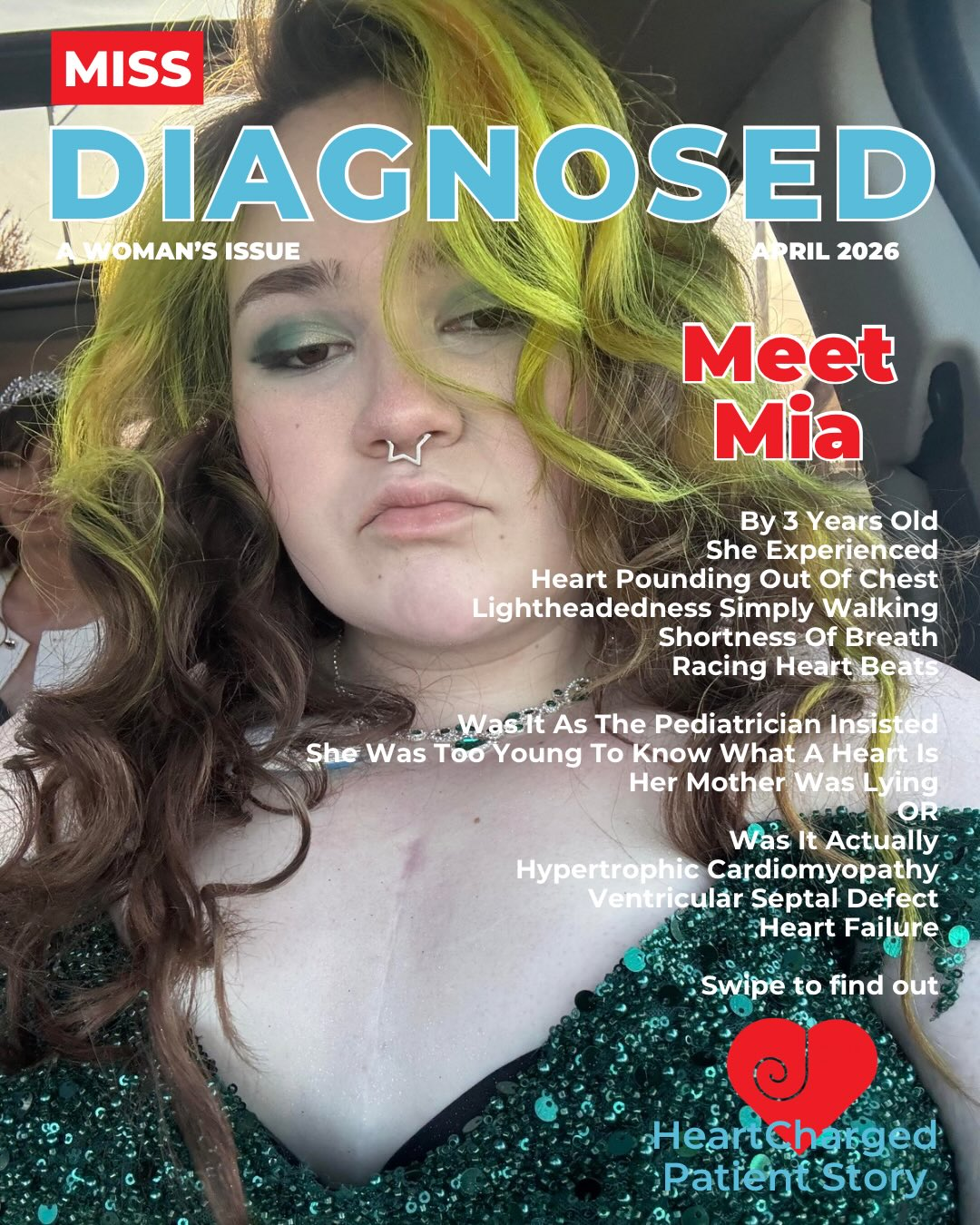
Meet Mia
Mia began experiencing heart symptoms at just 3 years old, but her concerns were dismissed until her father’s diagnosis led to testing that revealed her own HCM. After childhood open-heart surgery, ICD shocks, worsening heart failure, and being listed for a heart transplant at 17, Mia shares her story to raise awareness about invisible illness and the support young patients deserve.
Patient Story Misdiagnosed
Early Symptoms
Hi, my name is Mia!
When I was 3 years old, I would consistently run around the house telling my mom my heart was racing and that I could feel it pounding out of my chest.
I was told by my pediatrician that it was normal and that I didn’t even know what a heart was. He even told my mom that she was lying about the severity of my symptoms.
I couldn’t even walk without being short of breath or lightheaded back then.
I was only diagnosed because my father, who had no previous symptoms, had to be taken to the emergency room for “severe heartburn” that turned out to be mid-stage HCM and almost a complete mitral valve leak.
This led to him needing an emergency septal myectomy and valve stabilizer put in.
It also led to my extensive testing. There was genetic testing. And there was a simple ECG that showed proof of left ventricular thickness.
That could have been done way earlier.
Childhood Surgery and Complications
By age 10, I had to have open-heart surgery because I too needed a septal myectomy.
I also had an ICD placed. My left ventricle was 3.3 cm. (Note: 0.9 cm would have been more normal at her age.) It had obstruction going into the surgery. Immediately following surgery, it was around 1.2 cm.
The surgery went well, but unfortunately, when I was coming out of the operating room, I woke up and was shocked by my ICD six times in a row, leaving me with severe PTSD and anxiety around a device in me.
The ICD was supposed to bring me relief, knowing I was protected from severe arrhythmias and possible cardiac death.
By the time my one-year check-up came around, my cardiologist realized my left ventricle thickness was returning and that during the surgery they left a hole in my heart.
This led to early-onset heart failure and the presence of diastolic dysfunction in my heart.
For years after, I tried every beta blocker, calcium channel blocker, and anti-arrhythmic available for pediatric patients.
Nothing helped my severe chest pain, shortness of breath, angina, lightheadedness, or general lack of blood flow throughout my body.
I went through every cardiac test possible to try and see if my obstruction came back.
Losing My Quality of Life
By age 15, I had no quality of life.
I couldn’t focus in school. I gained so much weight, and I couldn’t exercise at all, let alone walk around school and function as a “normal person.”
My left ventricle measured at 4.5 cm with no obstruction and severe heart failure.
My doctors had mentioned the idea of a heart transplant before, but there was always one more medication we could try.
For the next few years, we also did testing. We finally talked about being listed for a heart transplant at age 17.
I was listed on August 12, 2024.
I missed my first day of senior year because of it.
I didn’t get to walk at graduation. It was devastating.
I almost missed my senior prom because of AFib.
The Social Impact of Invisible Illness
On top of everything else since kindergarten, I had constant testing and appointments, which led me to miss so much school.
Then after I had my open-heart surgery, I just declined so much more.
I had come back and felt very welcome, and like things were normal again for about the first few months.
Then my symptoms started getting worse and I started gaining weight. Kids started making fun of me constantly.
In middle school it got pretty bad. I had qualified for a Make-A-Wish, and plenty of kids told me to “ask for more friends” or “ask to lose weight.”
It was pretty horrific and just made me not want to go to school more, but I prevailed.
That was until junior year of high school, when I started declining pretty badly and had to use a wheelchair to get around.
I lost the majority of my friends and I could hardly go to school.
I felt so alone.
Some of my best friends told me:
“You’re no longer fun to be around and we can’t do anything with you, and it feels depressing waiting for this heart of yours to get sicker.”
I felt astonished.
I realize it felt hard for people watching me go through consistent doctor’s appointments, cardiac rehab, and being in and out of the hospital.
Imagine how I felt living it and just wanting support from my friends to have some sense of normalcy.
Don’t even get me started on when I would post from the hospital and kids would tell me to take it down because no one cared, even going so far as to screenshot my post and add a poll to it to see who really cared.
Thankfully, I have a few good friends, like the people from my cabin at Camp Odayin, a camp for kids with heart conditions, who helped me out of that dark place.
But no one really talks about the invisibility of HCM and how awful people can be when they can’t see, even when you have an open-heart scar, how truly sick you are.
Why I’m Sharing My Story
I’m sharing my story to talk about the invisibility of HCM and how people with our disease deserve support from the people around us and not to be scrutinized for how we look, or how our lives “complicate theirs.”
There needs to be more information out there about HCM and diseases like it.
Terms to Know in Mia’s Story
HCM: Hypertrophic cardiomyopathy. HCM is characterized by causing the left ventricle wall of the heart to thicken, making it harder to pump blood.
Obstruction With HCM: When the thickening of the ventricle wall causes blood flow from the left ventricle to be blocked or obstructed when it should be pumping blood out into the body.
Mitral Valve Leak: When the mitral valve between the heart’s left chambers fails to close tightly and blood can flow back into the left atrium instead of moving out into the body as it needs to.
Septal Myectomy: A type of open-heart surgery used to treat HCM. A portion of the thickened heart muscle is removed to alleviate obstruction and restore room in the left ventricle. Blood should then be able to pump out more easily. The muscle can grow back.
Heart Failure: The term used when the heart is too stiff or weak to pump enough blood to meet the needs of the body. The heart is failing in its function.
Diastolic Dysfunction: When the ventricle is stiff or doesn’t relax quickly enough to allow it to fill as fully as it should.
ICD: An implantable cardioverter-defibrillator. A device surgically implanted into the body to help prevent sudden cardiac arrest by delivering shocks when the patient has life-threatening arrhythmias.
Beta-Blocker: A medication meant to lower blood pressure and heart rate.
Calcium Channel Blocker: A medication meant to manage high blood pressure, angina, and arrhythmias by relaxing and widening blood vessels to improve blood flow to the heart.
Antiarrhythmic: A medicine meant to suppress abnormal heart rhythms, or arrhythmias, by regulating the electrical system of the heart and stabilizing heartbeats.
Angina: Chest pain from reduced blood flow, and therefore reduced oxygen, to the heart.
AFib: Atrial fibrillation. A rapid, irregular, chaotic heartbeat that can lead to sudden cardiac arrest, heart damage, stroke, blood clots, or heart failure.